How to Select a Fluid Bed Dryer for Efficient Industrial Drying
Wiki Article

Fluid Bed Dryers in Modern Manufacturing: Improving Efficiency and Long-Term Performance
Manufacturers increasingly evaluate equipment according to its contribution to the entire production process rather than its performance in isolation. Drying can influence product quality, energy use, production scheduling, labour requirements, and the efficiency of downstream operations. A fluid bed dryer can be a suitable solution for selected particulate materials because it combines heat transfer with controlled particle movement. However, achieving reliable long-term performance requires the right equipment design, a well-developed process, and a maintenance strategy that reflects actual production conditions.
The fluid bed dryer guide available from JSK Engitech introduces this industrial technology and its relevance to manufacturing. For businesses considering new equipment or reviewing an existing drying process, the key question is how well the dryer meets the material, production, quality, and safety requirements of the facility.
Why Drying Efficiency Matters in Manufacturing
Drying affects the transition between wet processing and later manufacturing stages. If moisture removal is inconsistent, material may require additional handling, reprocessing, or investigation before it can be used. If a drying cycle takes longer than expected, it may also affect the production schedule and the availability of equipment for the next batch.
Efficiency should therefore be evaluated through a combination of measures. These may include the amount of moisture removed, total cycle time, energy consumption, product quality, cleaning requirements, and equipment availability. Focusing only on the shortest possible drying time can overlook important costs or create quality risks.
Evaluate Performance at the Process Level
A drying system interacts with upstream material preparation and downstream operations. The moisture content and physical characteristics of incoming material affect how the dryer performs, while the condition of the dried material may influence blending, packaging, storage, or other subsequent steps.
Reviewing the entire process can reveal opportunities to improve consistency. For example, controlling variations in the incoming feed may be more effective than repeatedly adjusting the dryer to compensate for inconsistent material. Similarly, a clearer endpoint-testing procedure may help reduce unnecessary cycle extensions.
How Fluidization Supports Heat and Mass Transfer
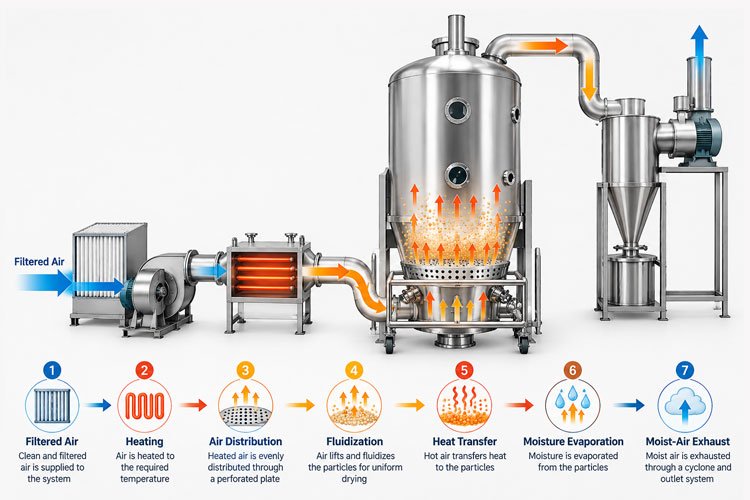
In a fluid bed dryer, process air moves upward through a distribution plate and suspends suitable particles. The movement increases contact between the drying air and the material, allowing heat to transfer to wet particles and moisture to evaporate. Moisture-laden air then exits through the exhaust system, with filtration arrangements designed to retain product where required.
The effectiveness of this process depends on achieving the appropriate balance between airflow, particle movement, and heat input. If airflow is too low, the bed may not fluidize consistently. If it is too high, particles may become entrained in the exhaust and energy use may increase. Product properties also influence how readily the bed responds to changes in operating conditions.
Understand the Limits of the Technology
Fluid bed dryers are not equally suitable for every material. Sticky substances, highly cohesive powders, very fragile particles, and materials with unusual thermal characteristics may require specialised configurations or alternative drying approaches. A technical assessment should establish whether the material can be processed reliably within the intended operating range.
Where necessary, application testing can help establish an appropriate loading range, airflow requirement, temperature profile, and drying endpoint. The findings should be evaluated against the actual quality specification and expected production conditions.
Improving Energy and Resource Management
Heating and moving process air require energy, making air handling and thermal performance important areas for evaluation. Energy consumption depends on factors such as moisture load, incoming air conditions, heating method, exhaust losses, equipment configuration, and operating duration.
Manufacturers should begin by collecting relevant operating data. Comparing energy use with production volume and moisture removed can provide a more meaningful picture than reviewing utility consumption alone. A longer cycle caused by inconsistent feed moisture, for example, may have a different corrective solution from a cycle affected by a poorly maintained air handling component.
Practical Areas for Review
- Check that airflow settings are appropriate for the material and required fluidization pattern.
- Review the heating system and relevant temperature controls.
- Inspect filters and air distribution components according to maintenance procedures.
- Reduce avoidable idle operation where the production schedule permits.
- Evaluate whether loading and unloading arrangements contribute to unnecessary delays.
- Track energy consumption alongside batch size, cycle duration, and moisture removal.
Any change intended to reduce energy use must preserve product quality and process safety. Lowering temperature or airflow without validating the effect may increase drying time, create uneven moisture, or disrupt fluidization.
Automation and Process Monitoring
Modern manufacturing operations may use control systems to monitor temperature, airflow, process duration, and other relevant parameters. Automation can support repeatability by helping maintain defined operating conditions and recording information needed for process review. The features available depend on the equipment configuration.
Automated controls do not eliminate the need for process understanding. Sensors must be suitable for their intended purpose, measurement systems should be maintained, and alarms should be linked to clear response procedures. Operators must understand what the measurements indicate and when intervention is required.
Use Data to Identify Process Variation
Historical records can help manufacturers compare batches and identify patterns. Differences in drying time may correlate with initial moisture, loading, filter condition, or other operating variables. Investigating these relationships can support targeted corrective actions rather than relying on repeated trial and error.
Useful data should be reliable and consistently recorded. Where measurements are used to make decisions about product release or controlled manufacturing processes, the method and records should meet the relevant quality requirements.
Integrating Drying Equipment Into a Production Line
Equipment selection should account for how the dryer connects with the rest of the manufacturing facility. Material must be transferred into the dryer, processed, discharged, and moved to the next stage. Poorly coordinated interfaces can create bottlenecks even when the drying chamber itself has adequate capacity.
Evaluate the feed system, discharge arrangement, available floor space, utility connections, exhaust routing, access for maintenance, and the time needed for cleaning or product changeover. If the facility handles several products, assess how the equipment will be cleaned and prepared between production runs.
Production planning should also account for the complete batch cycle. The drying time is only one part of equipment utilisation, and the time required for loading, discharge, inspection, and cleaning can influence the number of batches completed during a shift.
Quality, Hygiene, and Safety Requirements
Equipment should be designed and operated according to the properties of the material and the requirements of the industry. Pharmaceutical and food manufacturers may need particular attention to product-contact materials, cleaning procedures, contamination control, and documented process requirements. Chemical processing may involve additional controls for exposure, corrosive substances, or combustible dust.
These requirements should be considered before selecting the equipment rather than added after installation. The facility's engineering, quality, and safety teams should identify the applicable requirements and ensure that the proposed configuration addresses them.
Planning for Long-Term Equipment Reliability
Long-term performance depends on preventive maintenance, access to replacement components, operator training, and clear technical documentation. A dryer that meets the initial process requirements may still experience avoidable interruptions if filters, seals, instruments, or other components are not maintained appropriately.
Develop a maintenance schedule using the manufacturer's recommendations and actual operating experience. Record inspections, repairs, recurring faults, and the effects of corrective actions. These records help establish whether maintenance intervals remain appropriate and whether particular components require closer attention.
When assessing suppliers, request information about installation requirements, commissioning, operating manuals, spare parts, training, and service arrangements. Confirm the specific scope of support in writing instead of assuming that every service is included in the equipment price.
Making a Well-Informed Equipment Decision
Manufacturers comparing drying technologies should define the process requirements before evaluating individual models. The assessment should cover the material, target moisture, throughput, operating schedule, product quality, energy requirements, maintenance needs, and relevant safety controls.
The JSK Engitech fluid bed dryer guide is a useful reference for learning about fluidized drying. Buyers should use technical discussions and, where appropriate, product testing to verify that the proposed equipment is suitable for their application. Capacity figures, performance estimates, and optional features should be interpreted in relation to the actual product and operating conditions.
Conclusion
Fluid bed dryers can contribute to effective industrial moisture removal when their design, controls, and operating procedures match the requirements of the material. Their long-term value depends on more than drying speed, including energy use, process consistency, integration with production, Fluid Bed Dryer maintenance, and safety.
Manufacturers planning to adopt or improve fluid bed Fluid Bed Dryer drying should assess the entire production process, establish measurable performance requirements, and confirm equipment suitability through appropriate technical evaluation. The JSK Engitech guide provides an introduction to the technology, while application-specific engineering and process verification help turn that knowledge into a practical equipment decision.
 Report this wiki page